


Dormant Bitcoin Whale Address Moves 4,500 BTC
1 source





Bitcoin Reclaims 50-Week MA Amid Sustained ETF Inflows and Institutional Accumulation
| 1h | 24h | 7d | 14d | 30d | 1y |
|---|---|---|---|---|---|
| 0.0% | 0.1% | 8.4% | 8.8% | 6.5% | 24.6% |
| Market Cap | $1.694T |
|---|---|
| Market Cap / FDV | 1 |
| Fully Diluted Valuation | $1.694T |
| 24 Hour Trading Vol | $36.906B |
| Circulating Supply | 20.089M |
| Total Supply | 20.089M |
| Max Supply | 21M |
| Total Treasury Holding | 1,915,562 |
 Sponsored
Sponsored
Sponsored
Sponsored
Sponsored
| 24h Range | $82,941.39 – $84,845.05 |
|---|---|
| 7d Range | $77,933.54 – $87,329.89 |
| All-Time High |
$126,080 33.1%
|
| All-Time Low |
$67.81 124255.8%
|
| $90,000.00 | 13.6% |
|---|---|
| $87,500.00 | 32.5% |
| $85,000.00 | 81.5% |
| $82,500.00 | 58.5% |
| $80,000.00 | 20.8% |
| $77,500.00 | 7.5% |
Bitcoin is the world's first decentralized cryptocurrency that enables peer-to-peer electronic cash transactions without intermediaries like banks or governments.
Bitcoin operates on a blockchain secured by proof-of-work mining and the SHA-256 cryptographic algorithm, making it virtually impossible to counterfeit or double-spend.
With a fixed supply cap of 21 million coins and programmatic halvings every four years, Bitcoin is designed as a deflationary digital asset often called "digital gold."
Bitcoin has achieved mainstream adoption through spot ETF approvals, corporate treasury holdings, and acceptance by governments and institutions worldwide.
Bitcoin was created by an individual or group using the pseudonym Satoshi Nakamoto, whose true identity remains unknown to this day. In October 2008, Nakamoto published the Bitcoin whitepaper titled "Bitcoin: A Peer-to-Peer Electronic Cash System," laying out the technical foundation for a revolutionary digital currency. The first Bitcoin block, known as the genesis block, was mined on January 9, 2009, marking the official launch of the Bitcoin network.
Nakamoto actively developed Bitcoin and communicated with the early community until mid-2010, when they handed over control of the network and disappeared from public view. Despite extensive investigation and speculation over the years, no conclusive evidence has emerged regarding Nakamoto's true identity. Nakamoto is estimated to hold approximately 1.1 million BTC mined during Bitcoin's early days, spread across roughly 22,000 wallet addresses. These coins have remained untouched since they were mined, and any movement would likely cause significant market impact.
Bitcoin operates as a decentralized peer-to-peer network where users exchange value directly without intermediaries. The network maintains a public ledger called the blockchain, which records all transactions chronologically. This ledger is distributed across thousands of computers globally, with each node maintaining an identical copy.
Transactions are grouped into blocks, with each block containing a cryptographic hash of the previous block, creating an immutable chain. New blocks are added approximately every 10 minutes through mining, where specialized computers compete to solve complex mathematical puzzles. The first miner to solve the puzzle adds the next block and receives newly minted bitcoins plus transaction fees.
No single entity controls the network. Changes require widespread consensus among users, miners, and developers. Users control their Bitcoin through private keys — cryptographic codes that authorize transactions and prove ownership. The smallest unit is a satoshi (0.00000001 BTC), allowing Bitcoin to function as both a store of value and medium of exchange.
Bitcoin Security: SHA-256 Hashing Algorithm
Bitcoin's security is fundamentally rooted in the SHA-256 cryptographic hash function, a proven algorithm also used to secure critical government and internet infrastructure. This function is essential to the network's operation: miners must use it to find valid hashes to add new blocks, and it is also used to create the digital signatures that verify transaction ownership and authorize payments.
The algorithm is designed to be collision-resistant and preimage-resistant, meaning it is computationally impossible to reverse-engineer an input from its output or find two inputs that produce the same output, making the network virtually impossible to counterfeit or brute-force.
Bitcoin's Proof of Work consensus mechanism is energy-intensive by design, requiring significant computational power to secure the network, which has led to widespread debate about its environmental impact. Critics highlight the network's substantial electricity consumption, which rivals that of entire countries, and its associated carbon footprint when powered by fossil fuels.
Proponents counter that this energy expenditure is justified to secure a global, decentralized financial system. They also point to market-driven incentives for miners to seek out the cheapest power sources, which often include "stranded" renewable energy (like excess hydro or solar) and the capture of flared methane gas, which can arguably help stabilize power grids and monetize otherwise wasted energy.
Securing Bitcoin means protecting private keys—the cryptographic codes that prove ownership and authorize transactions. The golden rule of Bitcoin security is "not your keys, not your coins," meaning whoever controls the private keys controls the associated Bitcoin. As a general rule, private keys and seed phrases should be kept offline and away from internet-connected devices.
Hardware wallets provide the highest security level for most users, and these are optimal for long-term storage of BTC. These physical devices store private keys offline and require physical confirmation for transactions.
Software wallets on computers or smartphones offer convenience but require stronger security practices. Users should enable two-factor authentication, use strong unique passwords, keep software updated, and avoid storing large amounts in hot wallets connected to the internet.
Users keeping Bitcoin on exchanges face different security considerations. While exchanges provide trading convenience, they control your private keys, and major exchange failures like Mt. Gox (2014) and FTX (2022) resulted in major customer fund losses. When choosing an exchange, select exchanges with strong security track records, enable all available security features, and transfer Bitcoin to personal wallets for long-term storage.
Bitcoin loss is permanent and irreversible. It is estimated that around 20 percent of all bitcoins are lost forever due to forgotten passwords, discarded hard drives, or deceased owners without backup plans, underscoring the importance of secure backup procedures and estate planning for Bitcoin holders.
Bitcoin's price is famously volatile, with the potential for large, rapid movements. This behavior is not a flaw but a natural characteristic of a new, global asset class with unique market dynamics.
The main drivers of volatility include:
Fixed Supply, Fluctuating Demand: This is the primary factor. Since the supply of Bitcoin is fixed and cannot be increased to meet demand, any shift in market sentiment — whether from positive news or negative FUD (Fear, Uncertainty, and Doubt) — has a direct and often immediate impact on its price.
A 24/7 Speculative Market: As a new asset, Bitcoin's price is heavily influenced by speculative trading. Because the market never closes, it reacts instantly to global news, regulatory announcements, and shifts in investor sentiment.
Market Liquidity: While the Bitcoin market is large, it is still smaller than traditional markets like gold or major stock indices. This means that large buy or sell orders (from "whales") can have a disproportionate effect, causing the price to move more sharply than in more liquid markets.
Macroeconomic Sensitivity: As Bitcoin has become a mainstream asset, its price has become increasingly sensitive to global macroeconomic factors, such as interest rate decisions by central banks, inflation data, and geopolitical events.
Bitcoin's value stems from solving the double-spending problem without trusted intermediaries, creating the first truly scarce digital asset with a fixed supply cap of 21 million coins enforced by transparent, unchangeable code.
Bitcoin's decentralized nature provides censorship resistance. No government, corporation, or individual can control the network, freeze accounts, or prevent transactions, making it particularly valuable in regions with unstable currencies or authoritarian governments. Once confirmed, transactions become practically irreversible.
Digital Gold Narrative
Bitcoin has earned the "digital gold" moniker because it shares many properties with the precious metal: it is scarce, durable, and not controlled by any government or central bank, making it an attractive store of value and a potential hedge against inflation.
Unlike physical gold, Bitcoin is:
Easily Portable: Billions of dollars in value can be sent across the globe in minutes.
Highly Divisible: It can be divided into 100 million smaller units (satoshis), making it useful for transactions of any size [cite: 45].
Easily Verifiable: Its authenticity can be proven on the blockchain without a trusted third party.
This narrative has been reinforced by mainstream adoption, including the approval of spot Bitcoin ETFs and the acquisition of BTC as a treasury asset by major corporations.
Scarcity (21 million cap)
Bitcoin's value is fundamentally anchored by its absolute digital scarcity, which is enforced by its code that dictates there will only ever be 21 million BTC. This fixed supply ensures no central authority can inflate the supply or devalue the holdings of its users.
This scarcity is programmatically reinforced by the Bitcoin Halving, which systematically reduces the rate of new Bitcoin issuance, making it progressively scarcer over time as demand grows.
The deflationary economic model contrasts sharply with inflationary fiat currencies. As demand grows while supply remains fixed and decreasing, basic economics suggests upward price pressure over time, making Bitcoin attractive as a long-term wealth preservation tool resistant to purchasing power erosion.
The Bitcoin halving is a predetermined event that reduces miner block rewards by 50 percent approximately every four years (210,000 blocks), controlling new coin issuance and ensuring the total supply approaches 21 million. This programmatic supply reduction mimics the increasing difficulty of extracting precious metals.
The halving schedule began with 50 BTC per block in 2009, reducing to 25 BTC (2012), 12.5 BTC (2016), 6.25 BTC (2020), and most recently 3.125 BTC (April 2024). Each halving reduces Bitcoin's inflation rate by half, making it progressively scarcer.
Historically, halvings have preceded significant bull markets, with substantial price increases following each event. The 2024 halving occurred in a unique environment with spot ETF approvals and increased institutional adoption. The next halving is projected for 2028, reducing rewards to approximately 1.5625 BTC. By 2140, all bitcoins will be mined, and miners will rely entirely on transaction fees for revenue.
Bitcoin ownership is distributed among individuals, exchanges, institutions, corporations, and governments. Understanding major holders provides insight into market dynamics and adoption trends.
Satoshi's Wallet
The largest known holder is Bitcoin's anonymous creator, Satoshi Nakamoto, who is estimated to have mined over 1 million BTC in the network's early days. These coins are spread across thousands of wallets and have famously remained untouched since 2010, effectively removing them from the circulating supply.
Institutions and Corporations
A significant amount of Bitcoin is held by publicly traded companies that use it as a treasury reserve asset to protect against inflation. Furthermore, the issuers of spot Bitcoin ETFs hold vast quantities of BTC in custody on behalf of their investors.
Governments
Several national governments have become major holders, primarily through the seizure of coins from criminal investigations, with some nations also exploring it as a strategic reserve.
Bitcoin's development follows a conservative approach that prioritizes security and backward compatibility over rapid feature deployment, primarily using soft forks that maintain compatibility with older versions of the protocol.
SegWit
Segregated Witness (SegWit) was activated in August 2017, fixing transaction malleability — a bug where transaction IDs could be altered before confirmation. This made it possible to build reliable second-layer solutions like the Lightning Network.
SegWit increased effective block capacity, allowing more transactions per block while maintaining the base limit. This increased throughput and reduced fees. SegWit addresses begin with "bc1" and offer improved error detection. As of late 2025, approximately 85 percent of Bitcoin transactions use SegWit.
Taproot
Taproot was activated in November 2021, introducing Schnorr signatures that allow multiple signatures to be combined into one. This makes multi-signature transactions indistinguishable from single-signature transactions, significantly improving privacy — Lightning Network channels can no longer be identified on-chain.
Combined with the new Tapscript language, Taproot enables more sophisticated smart contracts with lower fees. The upgrade's enhanced scripting capabilities enabled innovations including Ordinals and the BRC-20 token standard.
Lightning Network
The Lightning Network operates as a second-layer protocol enabling instant, low-cost payments by moving most transactions off-chain. Users open payment channels by locking funds on the Bitcoin blockchain, then exchange unlimited transactions off-chain. Only the final balance settles on-chain when channels close, dramatically reducing congestion and fees.
This enables micropayments with fees measured in satoshis and confirmation times in seconds. Network capacity has reached approximately 5,600 BTC as of mid-2025. Major exchanges including Kraken and Binance have integrated Lightning, and El Salvador leverages it for everyday Bitcoin purchases.
Innovation around Bitcoin leverages the chain’s security and network effects while adding new functionality without requiring changes to core protocol rules.
Bitcoin Ordinals
Ordinals emerged in January 2023, enabling NFT-like functionality directly on Bitcoin. The protocol assigns unique numbers to individual satoshis, allowing them to be inscribed with data including images, text, audio, and video. Unlike traditional NFTs that store metadata on centralized servers, Ordinal inscriptions embed complete files permanently on Bitcoin's blockchain.
BRC-20 Tokens
BRC-20 tokens emerged in March 2023 as an experimental standard enabling fungible token creation on Bitcoin using Ordinal inscriptions. The first token, ORDI, quickly gained trading volume on major exchanges, and hundreds more followed, reaching nearly $1 billion in cumulative market cap during peak periods.
BTCFi and Bitcoin Staking
BTCFi (Bitcoin Finance) refers to the growing ecosystem of decentralized financial applications being built on or around Bitcoin. While Bitcoin does not have native staking like other networks, new protocols are exploring ways to use locked BTC to secure other networks, generate yield, or issue "Bitcoin-backed" assets, bringing DeFi-like capabilities to the Bitcoin ecosystem
Bitcoin's journey from fringe technology to mainstream financial asset accelerated dramatically in recent years. Multiple adoption vectors including ETF approvals, corporate treasury holdings, and government recognition have legitimized Bitcoin as an investable asset class and alternative monetary system.
Bitcoin ETFs
Bitcoin ETFs (Exchange-Traded Funds) are regulated financial products that allow investors to gain exposure to Bitcoin's price without having to buy and hold the digital asset itself. These products trade on traditional stock exchanges, making Bitcoin accessible to a broad range of investors through familiar brokerage and retirement accounts.
The regulatory approval of spot Bitcoin ETFs that hold actual Bitcoin in the United States and other major markets marked a significant milestone. This event signaled growing regulatory acceptance and helped legitimize Bitcoin as a mainstream asset class for both individuals and institutions.
ETF vs. Direct Ownership
It is important to understand the key difference between holding an ETF and holding Bitcoin directly:
Bitcoin ETFs offer convenience. Investors do not need to worry about digital wallets or securing private keys, as the ETF issuer handles custody.
Direct Ownership gives you full control over your asset. Holding your own Bitcoin follows the core principle of "not your keys, not your coins," meaning you are solely responsible for its security. Investors in an ETF trust the fund to hold the underlying Bitcoin on their behalf.
Corporate Treasuries
Corporations adopting Bitcoin as treasury reserves represent a shift in corporate finance strategy, viewing Bitcoin as superior to cash in low-interest, high-inflation environments. Strategy pioneered this approach in August 2020, articulating Bitcoin as "digital property" that preserves purchasing power better than fiat currency exposed to monetary expansion.
The strategy involves converting cash reserves to Bitcoin through operational cash flow, debt issuance, or equity offerings. Proponents argue this protects shareholder value against currency debasement, while critics contend companies should focus on core operations rather than speculative allocation. The approach also introduces significant balance sheet volatility that many CFOs find unacceptable.
Adoption remains limited relative to total corporate cash holdings, with most companies viewing Bitcoin as too volatile for treasury reserves. However, the trend demonstrates Bitcoin's evolution from fringe technology to consideration-worthy treasury asset for public corporations.
Government Adoption
Government engagement with Bitcoin has evolved from hostility to cautious acceptance and strategic consideration. El Salvador became the first nation to adopt Bitcoin as legal tender alongside the U.S. dollar, marking the first sovereign embrace. While the initiative attracted international controversy and mixed results, it firmly established Bitcoin in global policy discussions.
In major economies like the United States, political discourse has also shifted toward acceptance, with some high-level politicians suggesting a strategic approach to Bitcoin reserves rather than liquidating seized coins . This signals increasing political legitimacy, with some state governments also exploring Bitcoin reserve legislation.
Generally, developed economies have moved toward accommodation and regulation; the European Union's MiCA regulation, for example, provides a comprehensive cryptocurrency oversight framework. Meanwhile, in countries facing economic isolation or hyperinflation, residents increasingly explore cryptocurrency as a vital store of value, despite official discouragement.
BTC tokens can be traded on centralized crypto exchanges. The most popular exchange to buy and trade Bitcoin is Binance, where the most active trading pair BTC/USDT has a trading volume of $1,591,857,571.76 in the last 24 hours. Other popular options include Coinbase Exchange and OKX.
The trading volume of Bitcoin (BTC) is $36,939,642,986.51 in the last 24 hours, representing a -13.20% decrease from one day ago and signalling a recent fall in market activity. Check out CoinGecko’s list of highest volume cryptocurrencies.
Bitcoin (BTC) reached an all-time high of $126,080 and an all-time low of $67.81. It’s now trading -33.10% below that peak and 124,255.80% above its lowest price.
Market capitalization of Bitcoin (BTC) is $1,693,988,098,593 and is ranked #1 on CoinGecko today. Market cap is measured by multiplying token price with the circulating supply of BTC tokens (20 Million tokens are tradable on the market today).
The fully diluted valuation (FDV) of Bitcoin (BTC) is $1,693,990,206,689. This is a statistical representation of the maximum market cap, assuming the maximum number of 21 Million BTC tokens are in circulation today. Depending on how the emission schedule of BTC tokens are designed, it might take multiple years before FDV is realized.
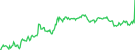
With a price increase of 8.40% in the last 7 days, Bitcoin (BTC) is underperforming the global cryptocurrency market which is up 9.20%.




Bitcoin’s market share is 56.95%, a 0.32% change in the last 24 hours. Compare against other major assets
| # | Exchange | Pair | Price | Spread | +2% Depth | -2% Depth | 24h Volume | Volume % | Last Updated | |
|---|---|---|---|---|---|---|---|---|---|---|
| 1 |
CEX
|
$84,324.34 | 0.01% | $48,114,901 | $26,029,795 | $1,579,293,687 | 3.81% |
Recently
|
||
| 2 |
CEX
|
$84,339.28 | 0.01% | $21,218,480 | $20,534,270 | $576,403,098 | 1.39% |
Recently
|
||
| 3 |
CEX
|
$84,314.60 | 0.01% | $12,038,462 | $10,049,784 | $244,120,771 | 0.59% |
Recently
|
||
| 4 |
CEX
|
$84,331.60 | 0.01% | $8,067,322 | $9,146,149 | $734,243,030 | 1.77% |
Recently
|
||
| 5 |
CEX
|
$84,313.59 | 0.01% | $6,014,033 | $7,621,112 | $389,619,494 | 0.94% |
Recently
|
||
| 6 |
CEX
|
$84,309.10 | 0.01% | $22,963,563 | $25,214,686 | $76,022,405 | 0.18% |
Recently
|
||
| 7 |
CEX
|
$84,324.34 | 0.01% | $2,802,975 | $2,784,373 | $180,984,897 | 0.44% |
Recently
|
||
| 8 |
CEX
|
$84,340.31 | 0.01% | $4,443,508 | $7,313,278 | $130,650,135 | 0.32% |
Recently
|
||
| 9 |
CEX
|
$84,317.72 | 0.01% | $16,107,963 | $21,136,043 | $314,417,399 | 0.76% |
Recently
|
||
| 10 |
CEX
|
$84,324.33 | 0.01% | $1,409,439 | $3,983,908 | $326,269,165 | 0.79% |
Recently
|
||
| # | Entities | Type | Activity in Last 30d | Total Bitcoin | Total Cost (USD) | Today's Value (USD) | mNAV | % of Total BTC Supply |
|---|---|---|---|---|---|---|---|---|
| 1 |
🇺🇸
Strategy
MSTR.US
|
Company
|
+5,553 BTC
|
846,000
|
$64,343,516,500 | $71,334,018,314 | 0.94x | 4.029% |
| 2 |
🇺🇸
United States
|
Government
|
-
|
329,693
|
- | $27,799,440,307 | - | 1.570% |
| 3 |
🇨🇳
China
|
Government
|
-
|
190,000
|
- | $16,020,642,411 | - | 0.905% |
| 4 |
🇬🇧
United Kingdom
|
Government
|
-
|
61,245
|
- | $5,164,127,602 | - | 0.292% |
| 5 |
🇺🇸
Twenty One Capital
XXI.US
|
Company
|
-
|
43,514
|
- | $3,669,064,389 | 1.18x | 0.207% |









 GeckoAI


 Or check it out in the app stores