







IBS
IBS Price



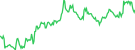
IBS Price Chart (IBS)
Switch & Compare
| 1h | 24h | 7d | 14d | 30d | 1y |
|---|---|---|---|---|---|
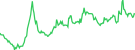
| 0.5% | 2.0% | 22.0% | 30.9% | 32.6% | - |
IBS Converter
IBS Statistics
| Market Cap | $5.072M |
|---|---|
| Market Cap / FDV | 1 |
| Fully Diluted Valuation | $5.072M |
| 24 Hour Trading Vol | $675,117 |
| Circulating Supply | 871,020 |
| Total Supply | 871,020 |
| Max Supply | ∞ |
 Sponsored
Sponsored
Sponsored
Sponsored
Sponsored
IBS Historical Price
| 24h Range | $5.79 – $5.91 |
|---|---|
| 7d Range | $5.79 – $7.47 |
| All-Time High |
$40.64 85.7%
|
| All-Time Low |
$5.79 0.6%
|
How do you feel about IBS today?

About IBS (IBS)
IBS is the native algorithmic token of the POTS Money protocol, designed as a collateral-backed monetary asset within a modular decentralized finance ecosystem on the BNB Smart Chain.
- Operates as a non-stable algorithmic token that maintains a minimum value floor through protocol-owned liquidity.
- Utilizes a three-layer backing system comprising liquidity pool (LP) collateral, a reserve buffer, and a safety treasury.
- Implements a "blackhole" mechanism where LP tokens from bond purchases are permanently destroyed to ensure irreversible liquidity.
What Is IBS
IBS serves as the "monetary layer" for the POTS ecosystem, functioning as an algorithmic asset that is neither a traditional stablecoin nor a pure governance token. It is designed to act as internet-native money that scales its supply based on real-time collateralization and market demand.
Value enters the system through bonding and collateral deposits. New IBS is minted only when sufficient LP collateral (minimum $1 USD per token) is provided, ensuring every unit in circulation is backed by verifiable on-chain assets.
Users can utilize IBS for staking, yield-generating strategies, and as collateral within the protocol's integrated lending markets. The token also facilitates decentralized payments and settlement within the broader POTS prediction market infrastructure.
As the ecosystem grows, the protocol’s "Solid Liquidity" model ensures that the liquidity floor increases over time, as 100% of LP tokens from bond sales are permanently locked. This creates a self-reinforcing flywheel where ecosystem activity deepens the token's backing.
What Makes IBS Unique
- Algorithmic Backing Floor: Unlike many algorithmic tokens, IBS maintains a structural price floor derived from permanently locked USDT value, ensuring it is never "empty air."
- Permanent Liquidity (Solid Liquidity): The protocol employs a unique mechanism that sends all LP tokens from bond purchases to a burn address, making the underlying liquidity mathematically permanent rather than just time-locked.
- Three-Layer Defense: The protocol protects its solvency through a multi-tiered architecture: primary LP collateral, a Reserve Bond Supply (RBS) buffer, and a Safety Treasury as a final line of defense.
- Modular Integration: IBS is natively integrated with Pots Market, a decentralized prediction infrastructure, allowing it to capture value from real-world event forecasting and probability signals.
What Can You Use IBS for?
- Staking and Yield Generation: Users can stake IBS to participate in the protocol's rebase pool and earn rewards based on ecosystem growth and bonding activity.
- Collateral and Lending: IBS can be used as collateral in decentralized finance lending primitives, allowing users to borrow against their positions and unlock capital efficiency without selling their assets.
- On-chain Payments: Due to its structural value retention and permissionless nature, IBS is designed for use in cross-border settlements and as a payment medium within the POTS ecosystem.
- Ecosystem Governance: As part of the POTS DAO, IBS holders can participate in the governance portal to influence protocol parameters and treasury management.
How Does IBS Work?
IBS uses an automated "Intelligent Bonding System" governed by smart contracts. The supply is managed by the Premium Index (Π), which is the ratio of the market price to the backed value of the token.
When the Premium Index is positive and sufficient liquidity exists, the protocol can mint new tokens through bonding. Conversely, the protocol activates burn mechanisms (RBS and YRF) when market conditions require supply contraction to protect the value floor.
As an application utility token, IBS facilitates transactions within the POTS ecosystem. Users pay protocol service fees for activities such as bonding, swapping, and participating in prediction markets, which are then redistributed or used to strengthen the treasury.
Team Info and Investors
The project is governed by the POTS DAO, a decentralized autonomous organization that manages the protocol's parameters and treasury. While specific individual founders or early venture capital investors are not detailed in the available documentation, the protocol emphasizes its commitment to on-chain transparency and algorithmic operation without central human discretion.
Where can you buy IBS?
IBS tokens can be traded on decentralized exchanges. The most popular exchange to buy and trade IBS is PancakeSwap (v2), where the most active trading pair IBS/BSC-USD has a trading volume of $675,122.00 in the last 24 hours.
What is the daily trading volume of IBS (IBS)?
The trading volume of IBS (IBS) is $675,117.09 in the last 24 hours, representing a -6.90% decrease from one day ago and signalling a recent fall in market activity. Check out CoinGecko’s list of highest volume cryptocurrencies.
What is the highest and lowest price for IBS (IBS)?
IBS (IBS) reached an all-time high of $40.64 and an all-time low of $5.79. It’s now trading -85.70% below that peak and 0.60% above its lowest price.
What is the market cap of IBS (IBS)?
Market capitalization of IBS (IBS) is $5,071,847 and is ranked #1620 on CoinGecko today. Market cap is measured by multiplying token price with the circulating supply of IBS tokens (870 Thousand tokens are tradable on the market today).
What is the fully diluted valuation of IBS (IBS)?
The fully diluted valuation (FDV) of IBS (IBS) is $5,071,847. This is a statistical representation of the maximum market cap, assuming total number of 3.4 Million ETH tokens are in circulation today.
How does the price performance of IBS compare against its peers?
With a price decline of -22.00% in the last 7 days, IBS (IBS) is underperforming the global cryptocurrency market which is down -2.60%, while underperforming when compared to similar Decentralized Finance (DeFi) cryptocurrencies which are down -6.10%.
How to add IBS (IBS) to MetaMask?
Adding IBS (IBS) to MetaMask allows you to view your token holdings, trade on decentralized exchanges, and more. To add them, you’ll need to import IBS as a token. You can copy IBS’s contract address (0x255e746abb8d9acac00d6d023e5e63e3b8dfa7cd) and import it manually, or if you've installed MetaMask's chrome extension, add IBS to MetaMask with one click on CoinGecko.
Add IBS to MetaMask.
IBS Markets
| # | Exchange | Pair | Price | Spread | +2% Depth | -2% Depth | 24h Volume | Volume % | Last Updated | |
|---|---|---|---|---|---|---|---|---|---|---|
| 1 |
DEX
|

|
$5.82 | 0.60% | $265,531 | $264,733 | $675,122 | 98.02% |
Recently
|
|

You may be interested in these latest crypto news


You may be interested in these crypto articles


Global IBS Prices
Related Coins You May Like



















 GeckoAI



 Or check it out in the app stores


